
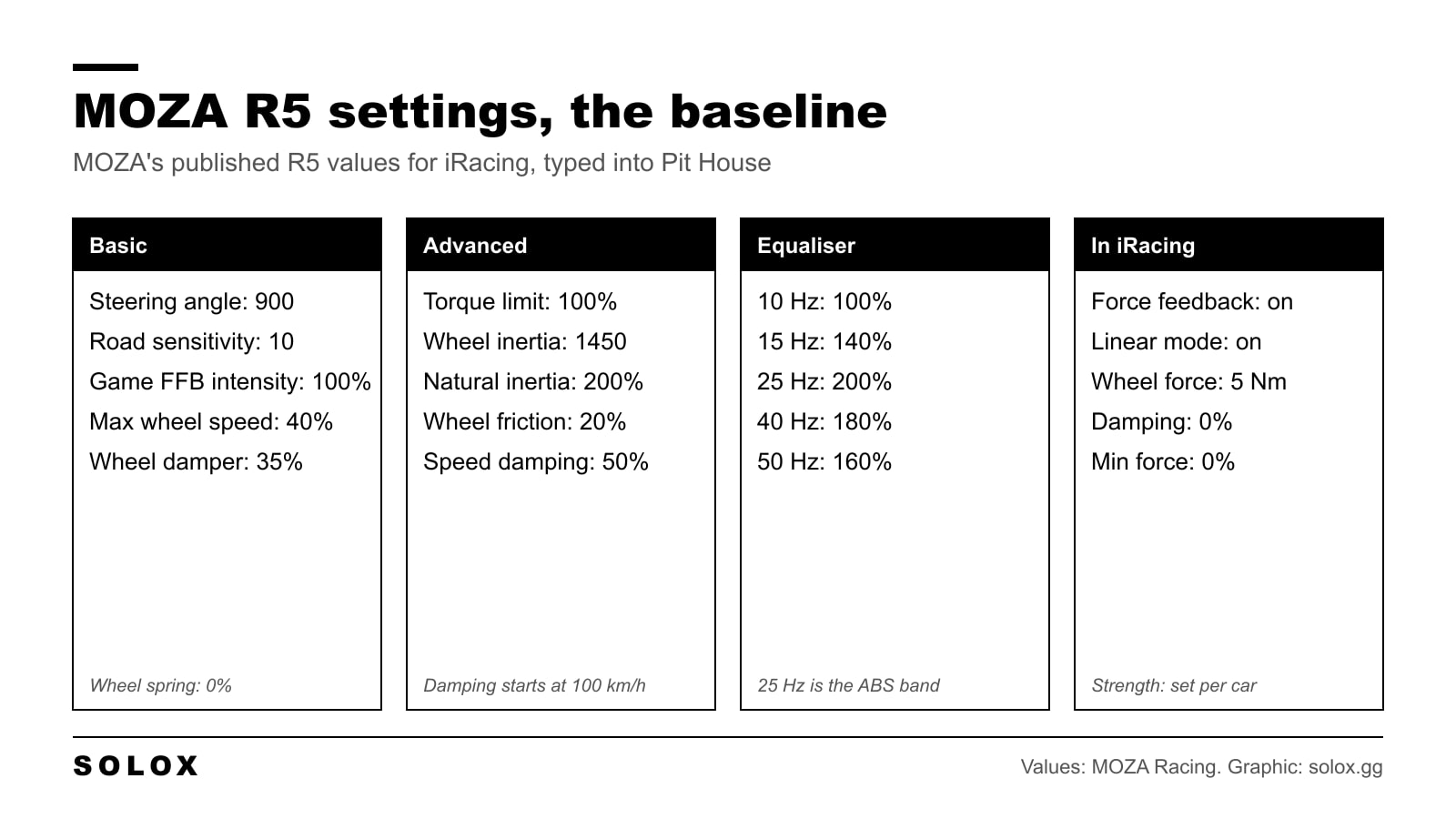
The short answer for MOZA R5 settings: in Pit House set 900 degrees, road sensitivity 10, Game FFB Intensity 100%, wheel spring 0%, wheel damper 35%, natural inertia 200% and wheel friction 20%. Leave the Maximum Output Torque Limit at 100%. Then set the strength inside each game.
Those are MOZA's own published R5 values, not a profile I made up. I checked all of them on 8 October 2026. Below are the full tables for Pit House, iRacing and Assetto Corsa, and the order I would change things in when the wheel does not feel right.
If you are still choosing a base, start with my MOZA wheel base guide. This page is for people who already have the R5 on the desk.
What the R5 is
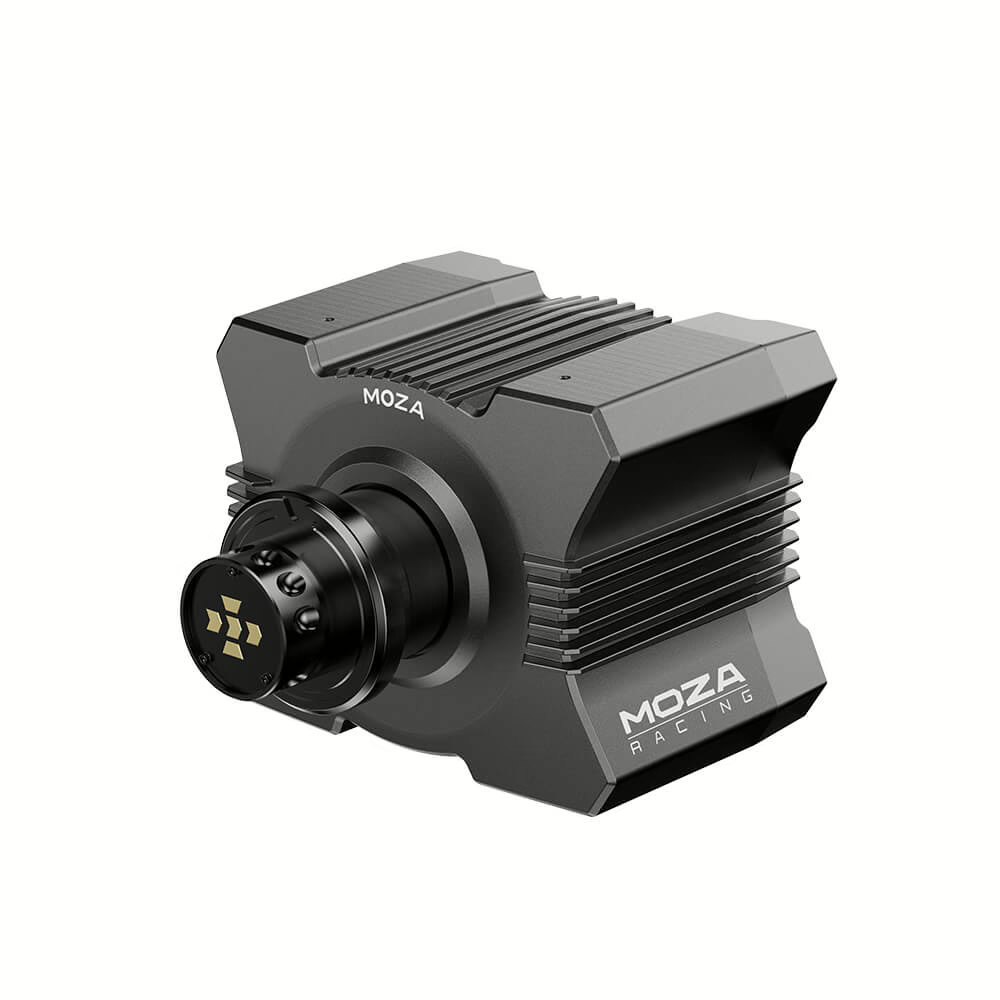
Image: MOZA Racing
| MOZA R5 | |
|---|---|
| Peak torque | 5.5 Nm, direct drive |
| Encoder | 15 bit |
| Maximum steering angle | 2700 degrees |
| USB rate | 1000 Hz |
| Platform | PC only (Windows) |
| Mounting | 4 holes on the bottom, table clamp in the box |
| In the bundle | R5 base, ES wheel (11 inch, 22 buttons, 10 RPM LEDs), SR-P Lite pedals (throttle and brake, no clutch) |
| Price | $379 on MOZA's US store on 8 October 2026 |
Two things in that table decide how you set it up.
5.5 Nm is not a lot. So you do not hold the base back in Pit House. You run it wide open and let the game do the shaping.
And it is PC only. No Xbox, no PlayStation. If you need a console, the R5 is the wrong base and no setting fixes that.
MOZA R5 Pit House settings
This is the baseline. MOZA publishes it for the R5 in its iRacing settings article, and it is a good start in any sim.
Basic settings
| Setting | R5 value |
|---|---|
| Maximum steering angle | 900 |
| Road sensitivity | 10 |
| Game FFB intensity | 100% |
| Maximum wheel speed | 40% |
| Wheel spring strength | 0% |
| Wheel damper | 35% |
Advanced settings
| Setting | R5 value |
|---|---|
| Professional game FFB intensity | 100% |
| FFB reversal | Off |
| Maximum output torque limit | 100% |
| Hands-off protection | On |
| Steering wheel inertia | 1450 |
| Natural inertia | 200% |
| Wheel friction | 20% |
| Speed-dependent damping | 50% |
| Speed-dependent damping starts at | 100 km/h |
FFB effect equaliser
| Band | R5 value | What MOZA says lives there |
|---|---|---|
| 10 Hz | 100% | Body bumps |
| 15 Hz | 140% | Kerbs at 80 km/h |
| 25 Hz | 200% | ABS vibration |
| 40 Hz | 180% | Kerbs at 160 km/h |
| 50 Hz | 160% | Grass |
Leave the Base FFB Curve linear. I explain when to touch it in my MOZA FFB curve guide. What every other slider does is in the MOZA Pit House settings guide.
One difference from the bigger bases. The R9 baseline uses steering wheel inertia 1800 and maximum wheel speed 50%. The R5 uses 1450 and 40%. So do not copy an R9 profile across. My MOZA R9 settings page has those numbers, and the smaller base has its own MOZA R3 settings page. The 12 Nm base is on my MOZA R12 iRacing settings page.
MOZA R5 iRacing settings
Use the Pit House baseline above. Then in iRacing:
| iRacing setting | R5 value |
|---|---|
| Enable force feedback | On |
| Use linear mode | On |
| Reduce force when parked | On |
| Wheel force | 5 Nm |
| Damping | 0% |
| Min force | 0% |
| Strength | Per car |
MOZA lists a strength of 60 next to those values. I would not copy one strength number across the garage. A GT3 and a Formula Vee do not put the same load through the steering. Drive a few clean laps, then use the auto button in the force feedback black box so iRacing sets the strength for that car.
The R5 product page also lists the iRacing 360 Hz mode. Switch it on in Pit House if you race there.
The game side, with the black box and what clipping looks like, is in my iRacing FFB settings page.
MOZA R5 Assetto Corsa settings
MOZA has a separate set for the R3 and R5 in its Assetto Corsa guide. It is softer on road detail and heavier on the damper than the iRacing set.
| Pit House | R5 value |
|---|---|
| Maximum steering angle | 900 |
| Road sensitivity | 8 |
| Game FFB intensity | 100% |
| Maximum wheel speed | 120% |
| Wheel spring strength | 0% |
| Wheel damper | 60% |
| In Assetto Corsa | R5 value |
|---|---|
| Gain | 60 to 90%, depends on the car |
| Filter | 0% |
| Minimum force | 0% |
| Kerb effects | 15% |
| Road effects | 15% |
| Slip effects | 10% |
| ABS effects | 0% |
Gain is the one you move per car. Start at 75%. If the wheel goes numb in the middle of a fast corner, the signal is clipping and the gain is too high. MOZA recommends Content Manager for this, because it shows you the clipping.
60% damper is a lot for my taste. If the wheel feels slow to come back to you on corner exit, that is the first number I would bring down.
Steering angle and feel by car type
MOZA's Pit House force feedback guide gives ranges by car type. These apply to the R5 as they are.
| Car type | Steering angle | Road sensitivity | Natural inertia |
|---|---|---|---|
| Formula | 360 | 8 to 10 | 100 to 150% |
| GT and sports cars | 540 | 8 to 10 | 200 to 300% |
| Road cars, rally, drift | 900 | 4 to 6 for a smoother wheel | Start at 200% |
The first two rows are MOZA's numbers. The 200% in the last row is the baseline value, because MOZA gives no range there.
Natural inertia is the slider I would use most on an R5. A GT car has real mass in the steering column. More inertia gives the wheel that weight without asking the motor for torque it does not have.
The same guide says Game FFB Intensity is "generally best at 100%" on the R3, R5 and R9, and that the torque limit is fine at 100% too. I agree. Turning a 5.5 Nm base down to 70% leaves you with less than 4 Nm, and then the small details go missing first.
The order I change things in
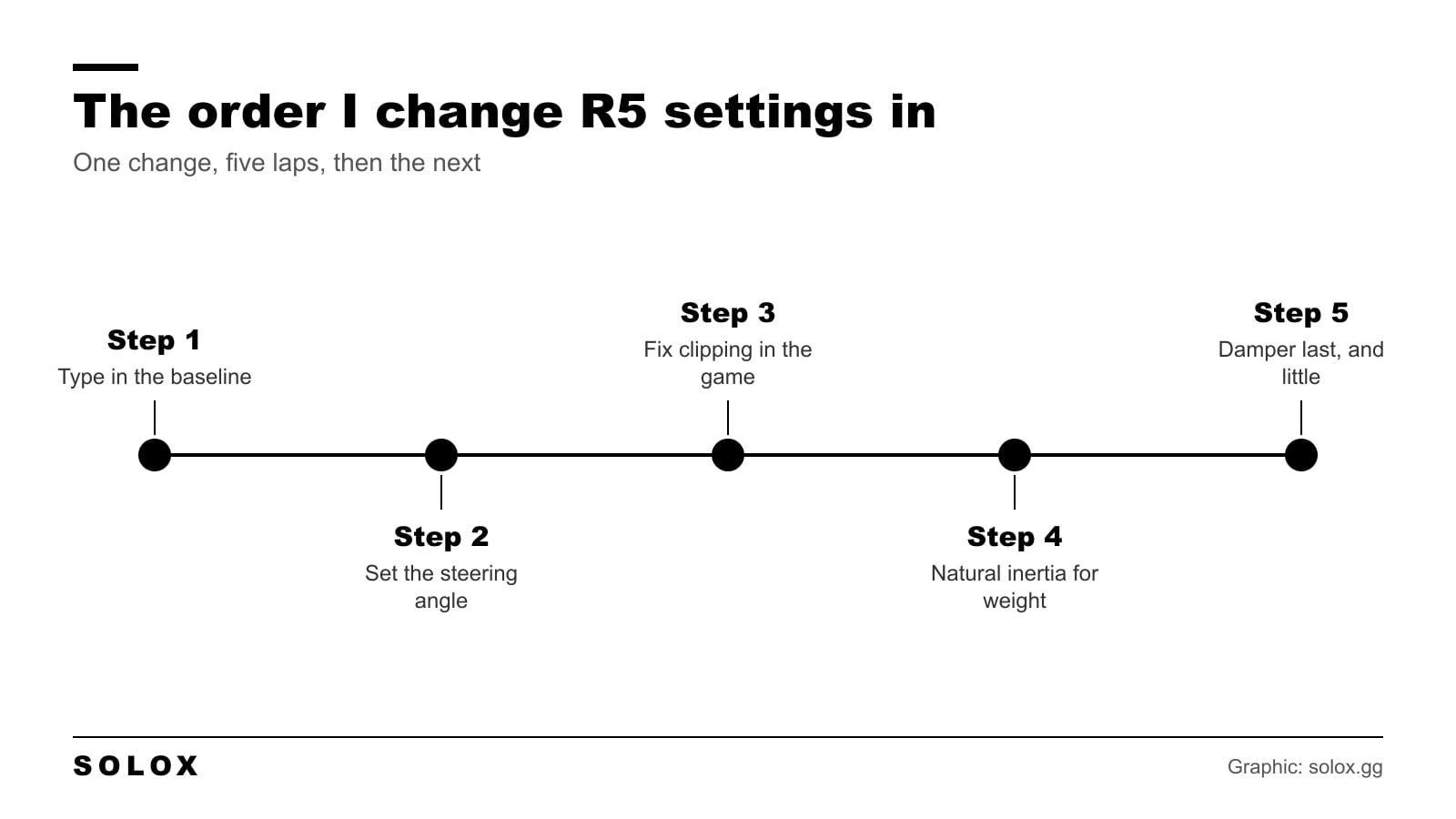
- Type in the baseline. All of it, before you judge anything.
- Set the steering angle for the car. Nothing else can be judged while the ratio is wrong.
- Fix clipping in the game. On a 5.5 Nm base this is the big one. If the game sends a clipped signal, Pit House only makes the clipped signal louder.
- Natural inertia for weight. Up for GT cars, down for formula cars.
- Damper and friction last, and little. They hide a problem more often than they fix one, and every point costs you detail.
One change, five laps, then the next. If you change three things and it feels better, you have learned nothing.
The equaliser comes after all of that. It is polish.
Common R5 problems
| What you feel | What I would change |
|---|---|
| Wheel goes light or numb in fast corners | Lower the gain or strength in the game. That is clipping. |
| Wheel shakes on the straight | Raise speed-dependent damping a little, or lower its start speed. |
| Wheel feels like a toy, no weight | Raise natural inertia towards 250 to 300% in GT cars. |
| Wheel is slow to return on exit | Lower the wheel damper in steps of 5. |
| Kerbs are too violent | Lower the 15 Hz and 40 Hz bands in the equaliser. |
| ABS buzz is too much | Lower the 25 Hz band from 200%. |
| Car turns more or less than the wheel | Match the steering lock in the game to the angle in Pit House. |
The R5 bundle pedals and wheel
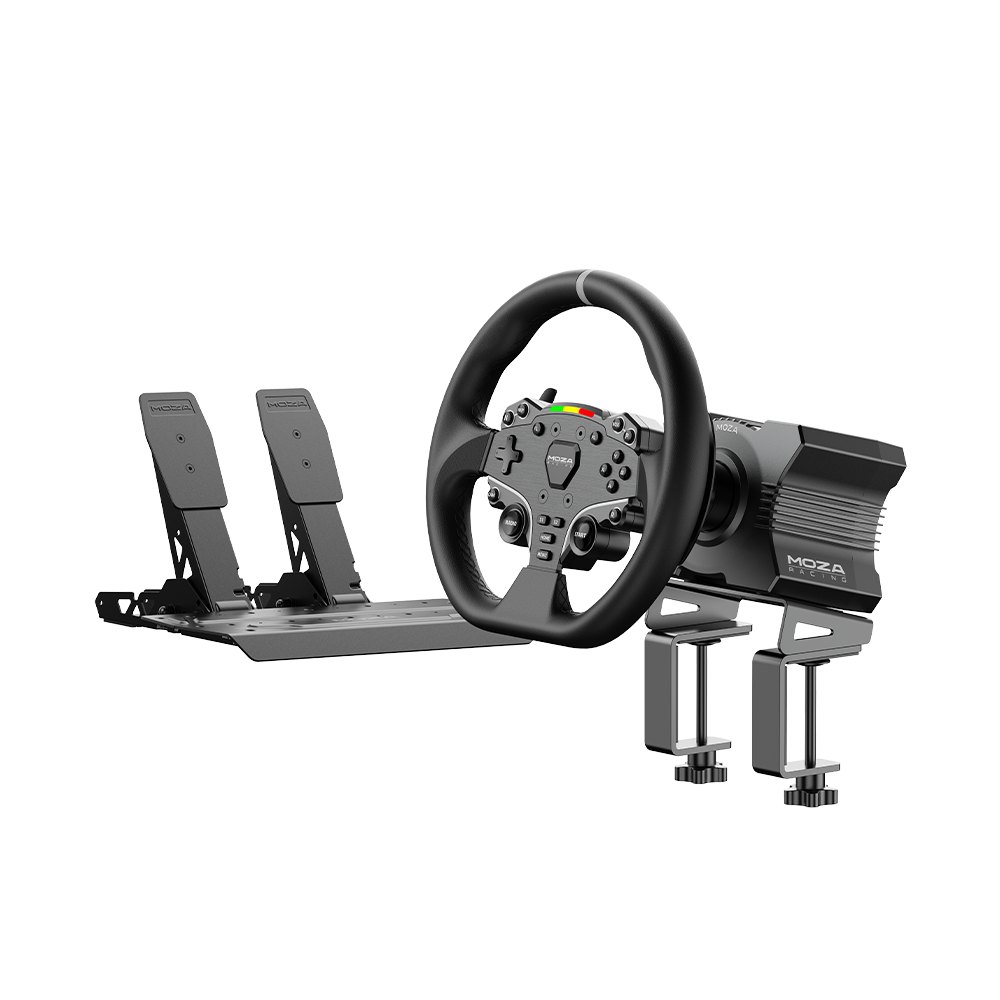
Image: MOZA Racing
The SR-P Lite pedals are two pedals with hall sensors. No clutch, and no load cell on the brake. That means the brake measures how far you push, not how hard. So calibrate both pedals in Pit House before the first lap, and be patient with your braking for the first week. Your foot has to learn a distance.
A stiffer brake will do more for your lap time than any slider on this page. I said the same in the wheel base guide and I still mean it.
Other games
- Assetto Corsa Competizione: the game values and the clipping check are in my ACC FFB settings page, in the MOZA section.
- Forza Horizon 6: the starting values and the telemetry setup for the rev lights are in my Forza Horizon 6 wheel settings page.
- Everything else: load the baseline, set the angle for the car, then find the clipping point in that game.
New to direct drive? Read direct drive wheels explained first. It makes the tables above easier to follow.
FAQ
What are the best MOZA R5 settings?
Start with MOZA's own baseline: 900 degrees, road sensitivity 10, Game FFB Intensity 100%, wheel damper 35%, natural inertia 200%, wheel friction 20% and the torque limit at 100%. Then set the strength in each game.
Should I run the MOZA R5 at 100% force?
Yes. MOZA's own guide says Game FFB Intensity and the Maximum Output Torque Limit are fine at 100% on the R3, R5 and R9. The R5 peaks at 5.5 Nm, so there is nothing to hold back.
What wheel force do I set for the MOZA R5 in iRacing?
5 Nm, with linear mode on, damping 0% and min force 0%. Set the strength per car with the auto button after a few clean laps.
What steering angle should I use on the MOZA R5?
360 degrees for formula cars, 540 for GT and sports cars, 900 for road cars, rally and drift. Match the steering lock in the game to the same number.
Does the MOZA R5 work on Xbox or PlayStation?
No. The R5 is PC only. It does not work on Xbox or PlayStation.
Can I use MOZA R9 settings on an R5?
Not as they are. MOZA gives the R5 its own values. Steering wheel inertia is 1450 on the R5 against 1800 on the R9, and maximum wheel speed is 40% against 50%.
Why does my MOZA R5 feel weak?
Check that Game FFB Intensity and the torque limit are at 100% in Pit House. Then check the game is not clipping. A clipped signal feels flat and weak in the corners where you need it most.