
RaceRoom is built around a steering wheel. I drive it on one, and if you want my force feedback values they are in the RaceRoom wheel and FFB settings guide. But a lot of people try the game on a pad first, because RaceRoom is free on Steam and a controller is what they already own.
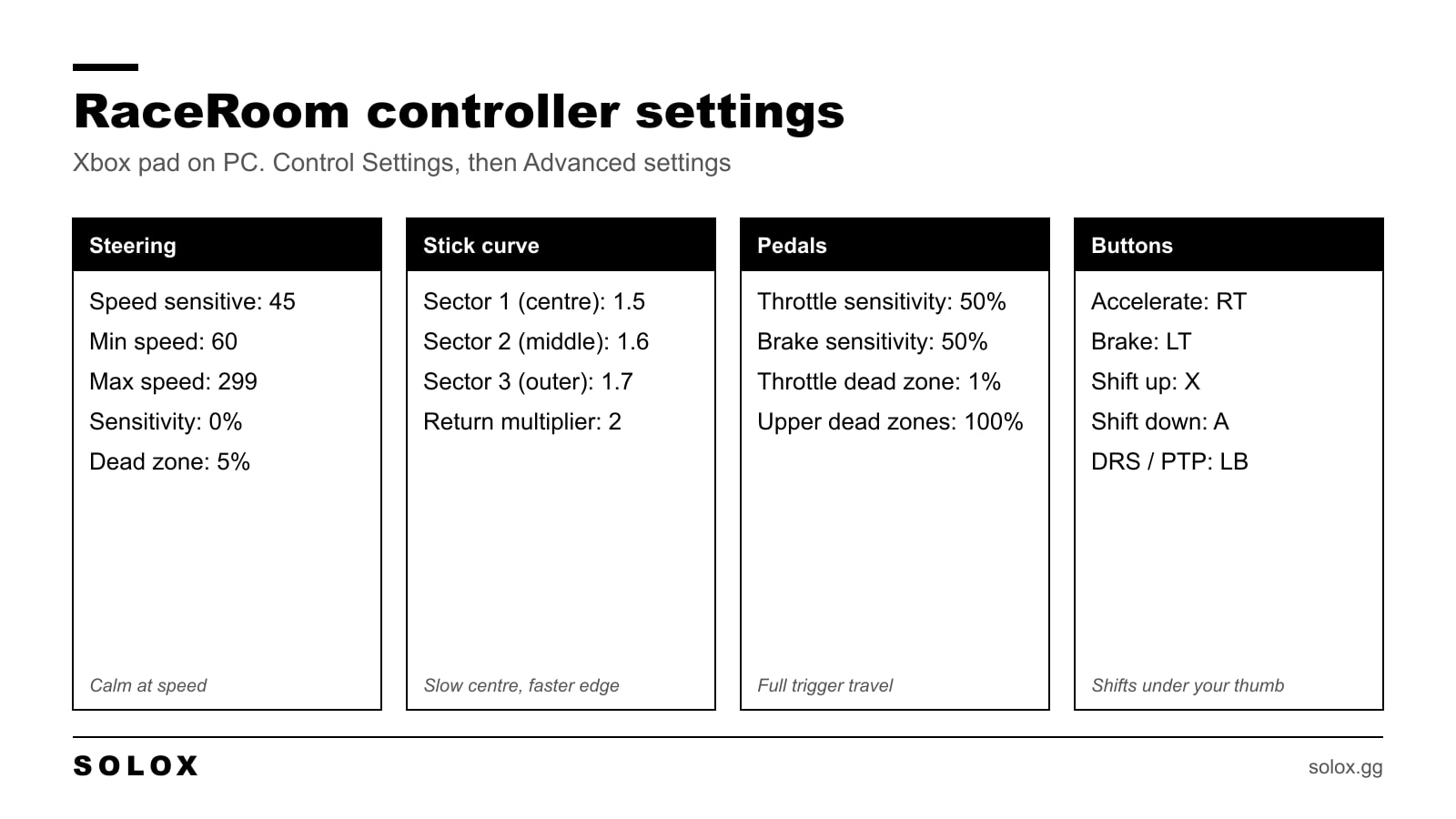
On default settings that first try is rough. The car darts left and right on the straight and snaps on corner entry. That is not the physics, it is the stick. A thumbstick moves about a centimetre from centre to full lock, and the game maps that to the whole steering range.
The fix takes five minutes. Below are the values I set up on an Xbox pad on PC, what each one does, and how to change your driving so the pad stops fighting you.
Can you play RaceRoom with a controller?
Yes. Xbox pads work as soon as you plug them in. RaceRoom is a PC game only, so there is no console version with a ready made pad profile, and that is why the setup work is on you.
You will be slower than the same driver on a wheel. With a pad you lose precision in the middle of the corner, where you want to hold a constant steering angle and feed in throttle. Entry and exit you can still do well.
If you are deciding whether to buy a wheel, read the best steering wheels for RaceRoom or my list of budget sim racing wheels. If you are staying on the pad for now, carry on.
Where the settings are
- From the main menu, click the gear icon at the top right.
- Open Control Settings.
- Pick your controller profile, then use Edit assignments for the buttons and Advanced settings for sensitivity and dead zones.
Do the buttons first, then the advanced page.
Button layout
| Action | Value |
|---|---|
| Steer left / right | Left stick |
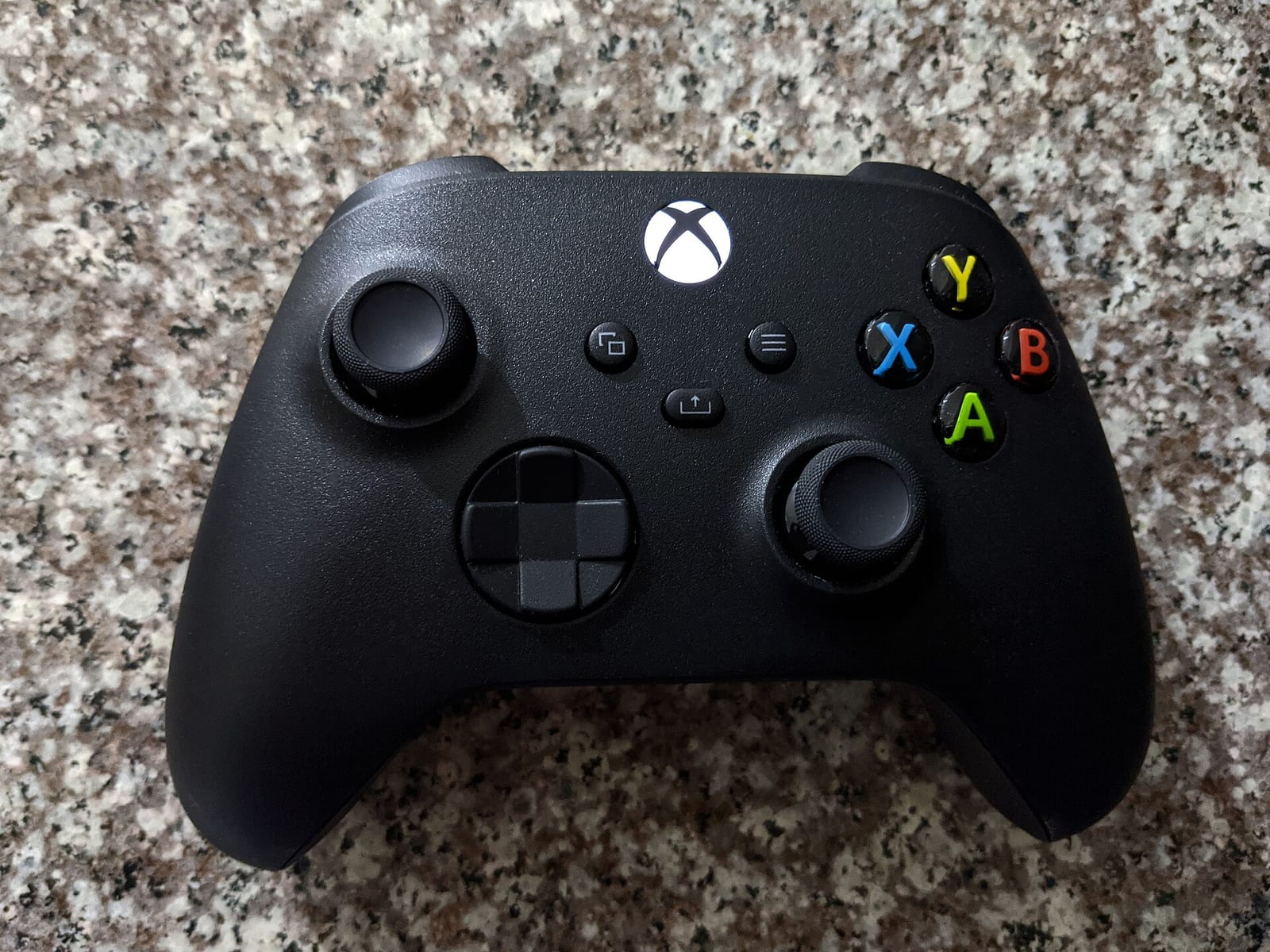
| Accelerate | RT |
| Brake | LT |
| Shift up | X |
| Shift down | A |
| DRS / Push to pass | LB |
| Next TC step | D-pad right |
| Previous TC step | D-pad left |
Two notes. I put the shifts on X and A because your right thumb rests there and you never have to take a finger off the triggers. And I map traction control steps to the D-pad because in a long race you want to turn TC down as the fuel burns off and the rear tyres wear.
If you would like to drive without a pad or a wheel at all, the RaceRoom keyboard controls page has the full key list.
Steering settings
| Setting | Value |
|---|---|
| Speed sensitive steering | 45 |
| Min steering speed | 60 |
| Max steering speed | 299 |
| Steering sensitivity | 0% |
| Steering dead zone | 5% |
| Return multiplier | 2 |
- Steering sensitivity 0% is the big one. It makes the stick as slow as the game allows around the centre. The car stops weaving on the straights.
- Speed sensitive steering 45 cuts how much the wheels turn as speed goes up. Between the min speed of 60 and the max of 299 the game blends the reduction in. At 250 km/h a full stick push no longer throws the car sideways.
- Steering dead zone 5% stops a worn stick from steering on its own. If your pad is new and does not drift, try 2 or 3%.
- Return multiplier 2 sets how fast the wheels come back to centre when you let go of the stick. Higher is faster. At 2 the car straightens quickly on exit without a snap.
The stick curve: analog sectors
| Setting | Value |
|---|---|
| Analog sector 1 (centre) | 1.5 |
| Analog sector 2 (middle) | 1.6 |
| Analog sector 3 (outer) | 1.7 |
RaceRoom splits the travel of the stick into three parts and lets you set the sensitivity of each one. Sector 1 is the third around the centre, sector 2 the middle, sector 3 the outer edge.
Rising numbers, 1.5 then 1.6 then 1.7, give you a gentle curve. Small corrections on a straight stay small. When you push the stick to the edge for a hairpin, you still get all the lock.
If the car feels lazy in slow corners, raise sector 3 to 1.9. If it is nervous in fast corners, drop sector 1 to 1.3. Change one sector at a time and do five laps before you judge it.
Throttle and brake settings
| Setting | Value |
|---|---|
| Throttle sensitivity | 50% |
| Brake sensitivity | 50% |
| Throttle dead zone | 1% |
| Throttle upper dead zone | 100% |
| Brake upper dead zone | 100% |
Sensitivity at 50% keeps both triggers linear. Half a trigger is half the pedal. That is what you want, because your finger learns the travel in a few laps and a curve only confuses it.
The upper dead zones at 100% mean you must press the trigger all the way to get full throttle or full brake. Lower them and the pedal hits 100% early, so you lose range to modulate with. On a trigger with two centimetres of travel you need every millimetre.
Gearbox and clutch
| Setting | Value |
|---|---|
| H pattern | Off |
| Double shift prevention | 0.05s |
| Clutch sensitivity | 20% |
| Clutch upper dead zone | 0% |
| Clutch biting point | 5% |
With a pad you use the auto clutch, so the clutch values barely matter. Leave them as above. Double shift prevention at 0.05 seconds stops one press from counting as two gears, which matters under braking when you are tapping down quickly.
Which driving aids to use on a pad
Do not switch everything off to feel like a pro. In real GT3 racing I had traction control and ABS on the car at every race, with dials on the wheel to adjust them. They are part of how the car is meant to be driven.
- Traction control: on, in the middle of its range. Turn it down one step at a time when you stop spinning the rears on exit.
- ABS: on where the car has it. A trigger gives you far less feel than a pedal with a load cell, and ABS covers the gap.
- Automatic gears: fine for your first hours. Go to manual once the lines are in your head, because you can then use engine braking to rotate the car.
- Stability control and steering help: off as soon as you can. They slow the car and hide the mistakes you need to feel.
How to be fast on a controller
This is where most of the lap time is. The settings only make the car drivable.
Move the stick slowly. Do not flick it to the edge. Roll it there over half a second. In a real car you never throw the wheel in either, the front tyres need a moment to take the load.
Brake in a straight line, and brake hard first. Squeeze the trigger to the stop at the start of the zone, then release it bit by bit as the corner comes. Trail braking on a pad is possible but leave it until the basics are solid.
One input at a time in slow corners. Brake, release, turn, then throttle. On a wheel you overlap them. On a pad the overlap is where the spins come from.
Short shift on exit. In second and third gear, change up early. Lower revs mean less torque at the rear wheels and less work for your right finger.
Pick a friendly car. Front wheel drive touring cars and the slower GT classes are much easier on a stick than a rear engined GT3 or an open wheeler. The free RaceRoom cars are enough to learn on.
Use the whole track. A wider line means less steering angle, and less steering angle is exactly what a pad likes.
More of this, for any input device, is in my RaceRoom driving tips.
If something feels wrong
| Problem | Change |
|---|---|
| Car weaves on the straight | Dead zone up to 7%, analog sector 1 down to 1.3 |
| Not enough steering in hairpins | Analog sector 3 up to 1.9, speed sensitive steering down to 35 |
| Car snaps in fast corners | Speed sensitive steering up to 55 |
| Wheels spin on every exit | Traction control up one step, short shift |
| Fronts lock without ABS | Brake sensitivity down to 40% |
| Car is slow to straighten on exit | Return multiplier up to 3 |
What changed in RaceRoom in 2026
The game is still getting big updates from KW Studios. The summer update of 4 August 2026 brought the DTM 2026 car pack and a new HUD that you can resize and move around. The control values on this page are set in the same Control Settings menu as before.
If the game stutters on your PC, sort that before you blame the pad. Input feels worse at a low frame rate. My RaceRoom graphics settings and the system requirements page cover that.
FAQ
Does RaceRoom support Xbox controllers?
Yes. An Xbox pad is recognised when you plug it in or pair it. You still need to change the advanced settings, because the default steering is too sharp.
Can I use a PS5 or PS4 controller in RaceRoom?
Yes, through Steam Input. Steam presents the DualSense or DualShock to the game as a standard pad. Use the same values as on this page. Cross is A and Square is X.
Is RaceRoom on PS5 or Xbox?
No. RaceRoom Racing Experience is a PC game on Steam. There is no console version.
What is the best steering sensitivity for a controller in RaceRoom?
0%, with speed sensitive steering at 45 and analog sectors at 1.5, 1.6 and 1.7. That gives a slow centre and full lock at the edge of the stick.
Can you be competitive online with a controller?
In the rookie and lower split races, yes. At the front of ranked GT3 races you will be giving away a few tenths a lap to wheel users, mostly in long corners.
Should I use automatic gears on a pad?
To start, yes. Switch to manual with auto clutch when you know the tracks. You gain engine braking and control over wheelspin on exit.
Do these settings work for a wheel?
No. Analog sectors and steering sensitivity are for sticks. For a wheel, use my RaceRoom wheel and FFB settings or the Logitech G29 and G920 settings.