
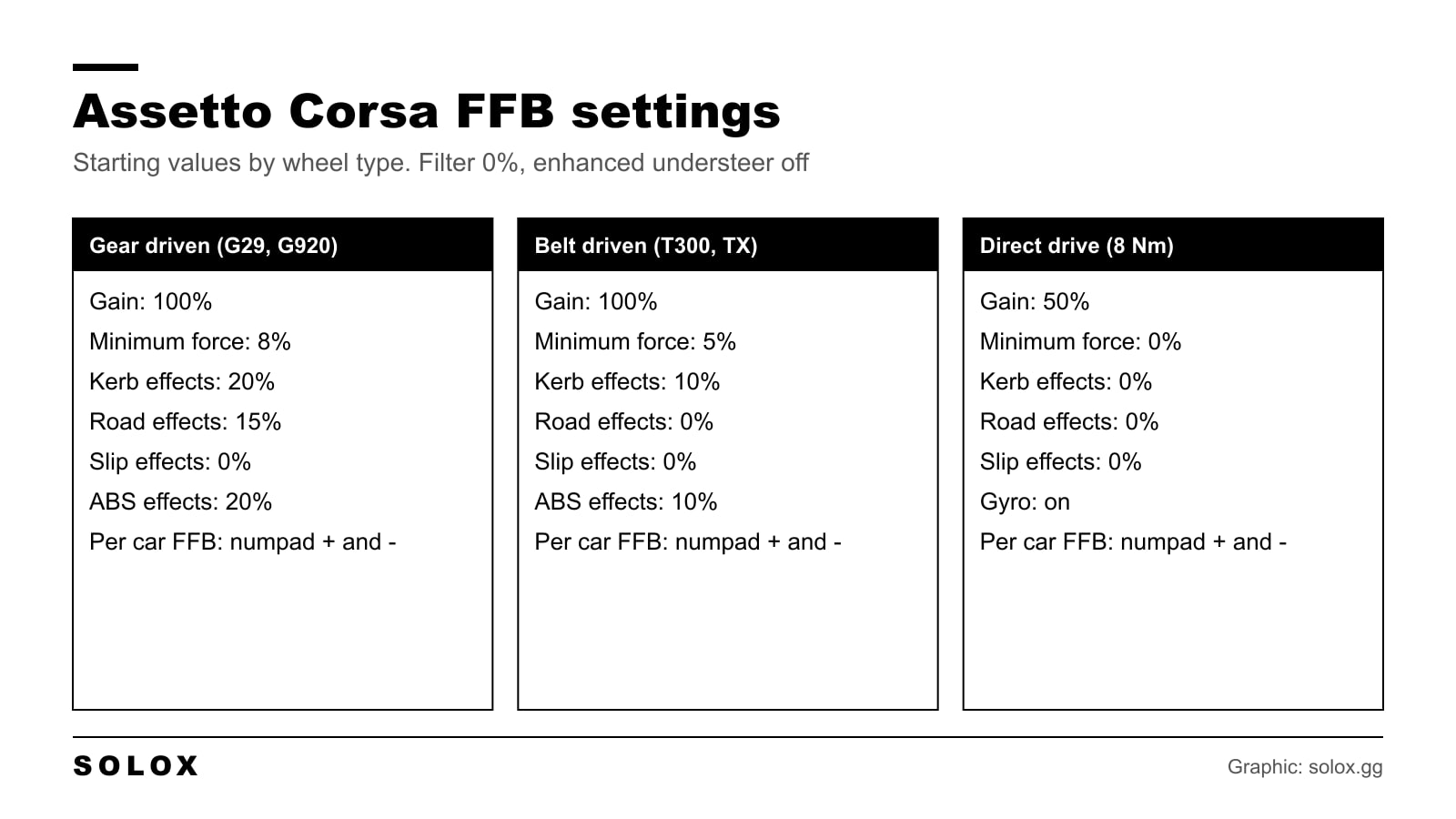
Assetto Corsa came out in 2014 and its force feedback is still one of the best you can buy. The signal that reaches your wheel comes from the tyres and the steering geometry of the car, with very little added on top. So the work is short. Send that signal to the wheel as clean as you can, at a strength your wheel can handle, and stay away from the sliders that add fake vibration.
The right numbers depend on the type of wheel you have. Here they are for each one, then what every slider does and how to adjust it.
Assetto Corsa FFB settings
| Setting | Gear driven (G29, G920, G923) | Belt driven (T300, TX) | Direct drive (8 Nm) |
|---|---|---|---|
| Gain | 100% | 100% | 50% |
| Filter | 0% | 0% | 0% |
| Minimum force | 8% | 5% | 0% |
| Kerb effects | 20% | 10% | 0% |
| Road effects | 15% | 0% | 0% |
| Slip effects | 0% | 0% | 0% |
| ABS effects | 20% | 10% | 0% |
| Enhanced understeer effect | Off | Off | Off |
| Half FFB update rate | Off | Off | Off |
These are starting values. A few points of difference between two drivers is normal.
If your wheel is one of the popular ones, I have a page with the driver settings as well as the game settings:
- Assetto Corsa G29 and G920 settings, with the G HUB values.
- Assetto Corsa Thrustmaster settings for the T300, TX, T248, TMX and T150, with the control panel values.
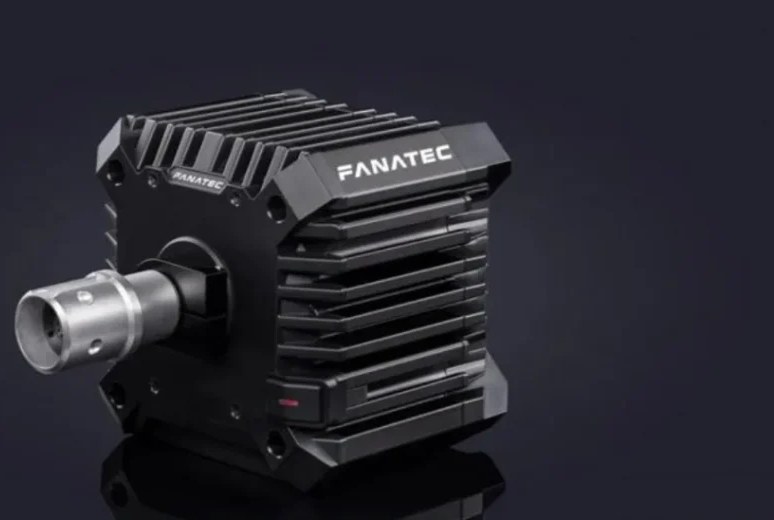
- Assetto Corsa Fanatec settings for the CSL DD and the CSL Elite, with the tuning menu.
If you do not know which type you own, my guide on direct drive, belt drive and gear drive explains the three.
Where the settings are
Open Options, then Controls. Pick Wheel / Custom at the top and run the configuration wizard once: turn the wheel fully left and right and press each pedal to the floor. Then open the Advanced tab. Force feedback is on the left. Steering and pedal settings are on the right.
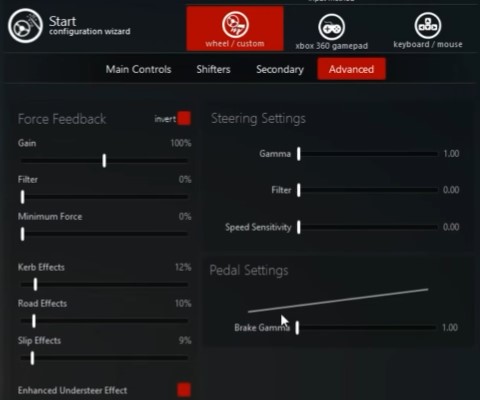
If you use Content Manager, the same values are in Settings, Assetto Corsa, Controls. My guide on how to install Content Manager covers the setup.
What each setting does
There are two families of sliders in that menu, and it helps to keep them apart.
Gain, filter and minimum force shape the real force, the one that comes from the physics of the car. Kerb, road, slip and ABS are effects the game adds on top of it. On a real car the wheel does not buzz because you are sliding. It goes light, or heavy, and that is the information. So the first family matters a lot and the second one I would keep low.
Gain. The overall strength. On a gear or belt wheel, which has 2 to 4 Nm, leave it at 100% so you use everything the motor has. On a direct drive base it is the opposite: the base has more torque than you need, so the gain comes down. Around 50% on an 8 Nm base and 70 to 80% on a 5 Nm base is where I would start.
Filter. It smooths the signal. It also delays it and removes detail. 0% on any modern wheel. The only reason to raise it is an old wheel that rattles and oscillates, and even then go up 5 points at a time.
Minimum force. It lifts the smallest forces so they are strong enough to move the wheel. This is the one that changes with the hardware, and it has its own section below.
Kerb effects. A vibration when a tyre is on a kerb. The physics already send the bump of the kerb through the steering. This adds a rumble on top. A little helps on a weak wheel. On a strong one it is noise.
Road effects. A vibration from the surface of the road. Same story. Assetto Corsa has many laser scanned tracks and their bumps are in the real signal already.
Slip effects. A vibration when the tyres slide. I would run it at 0%. A sliding front tyre makes the wheel go light, and you want to feel that with nothing over it.
ABS effects. A pulse in the wheel when the ABS of the car is working. It only does anything in cars that have ABS. Low or off.
Enhanced understeer effect. It exaggerates the drop in force when the front tyres go past their limit. It sounds useful. The problem is that the wheel then goes light earlier and more than the car does, so you start correcting for understeer that is not there yet. Off.
Half FFB update rate. It halves how often the game sends the force to the wheel. It exists for old hardware with problems. Off.
Minimum force by wheel type
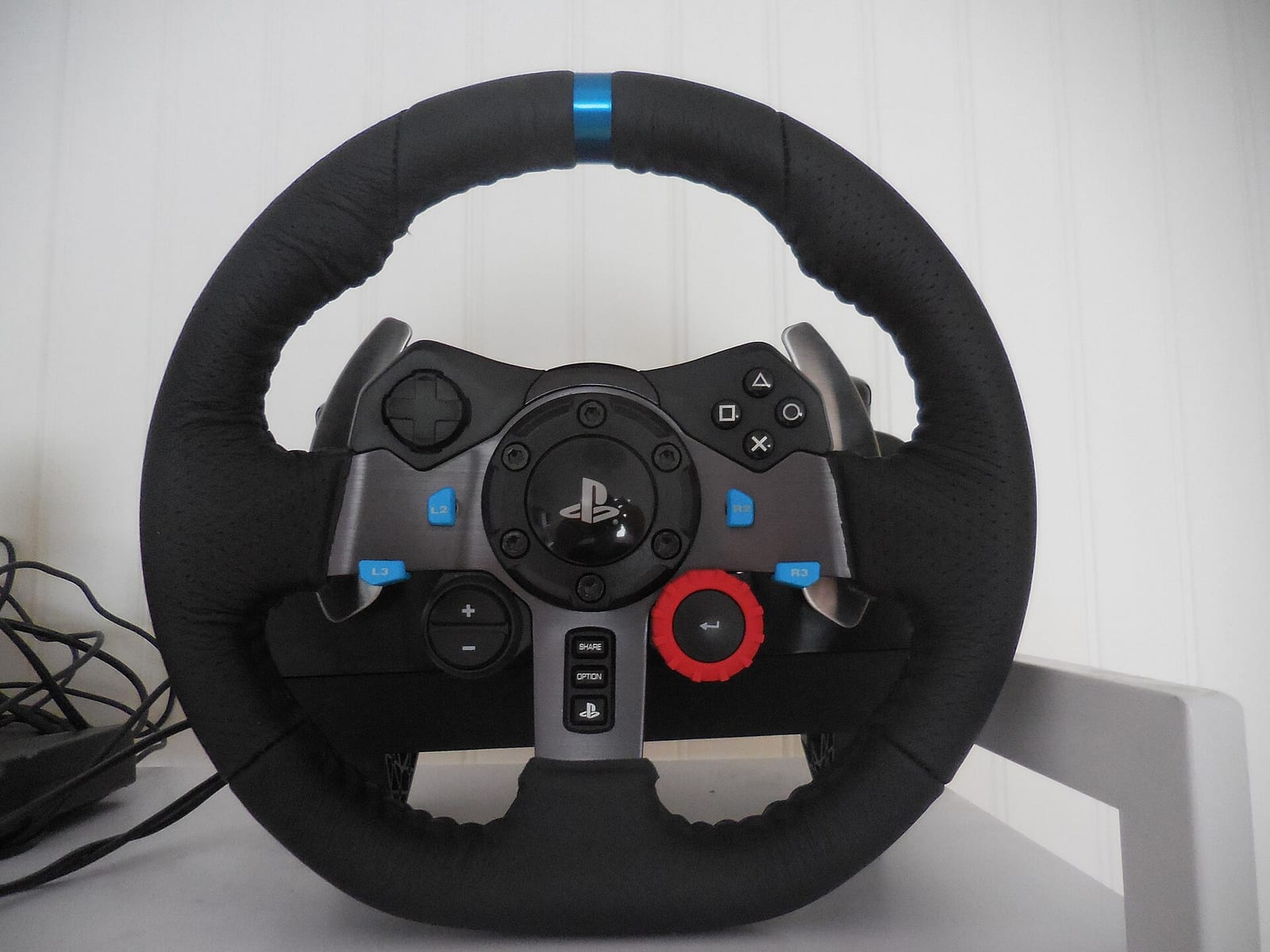
Every wheel with gears or a belt has some friction inside. A very small force from the game is not enough to beat that friction, so nothing reaches your hands. You feel it as a dead area around the centre of the wheel, mostly on the straights and at the start of a corner.
Minimum force raises those small forces above the friction. How much you need depends on the mechanism:
| Wheel type | Minimum force | Why |
|---|---|---|
| Gear driven: Logitech G29, G920, G923 | 5 to 12%, start at 8% | The gears have the most friction and the biggest dead area |
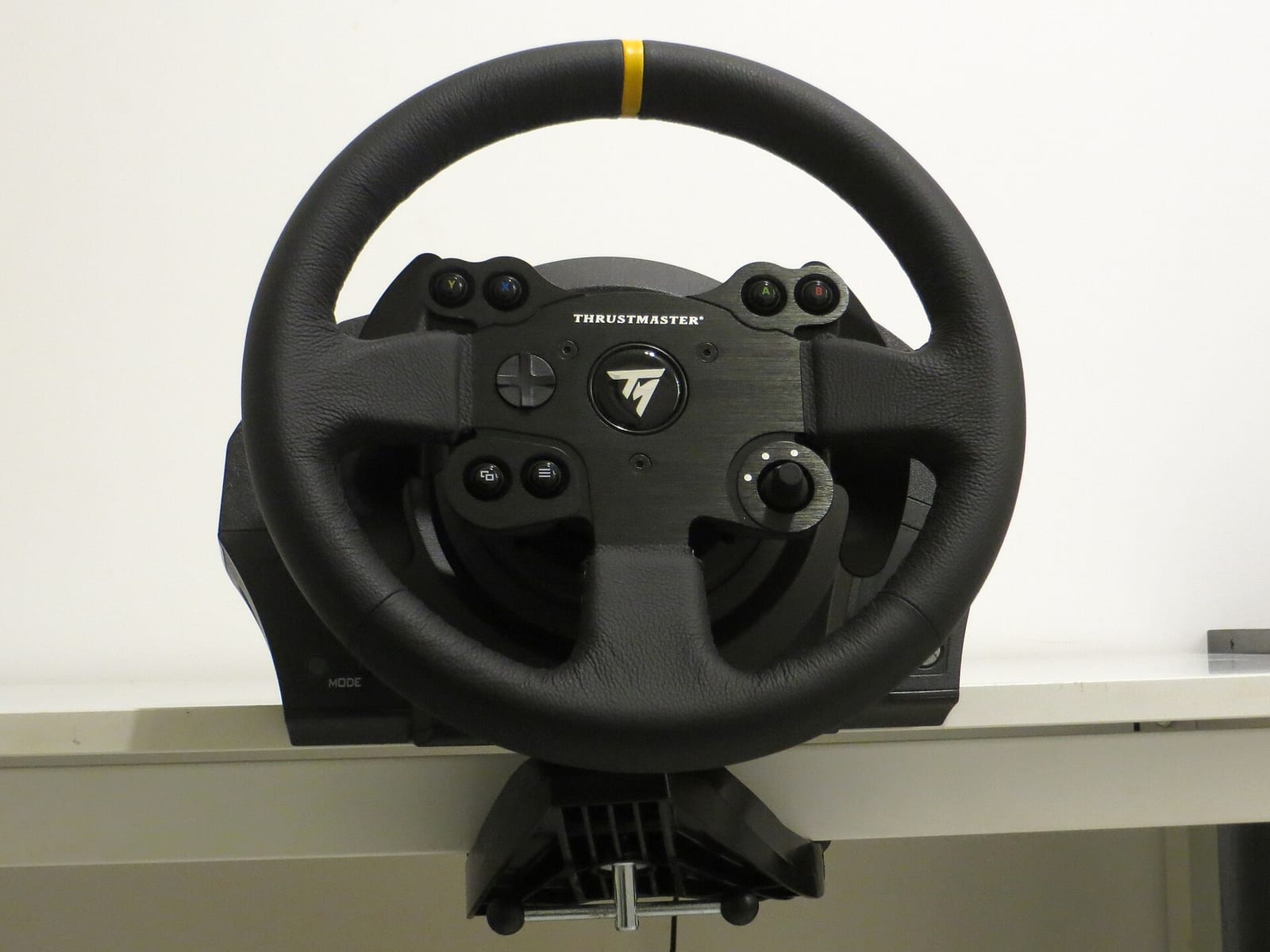
| Belt driven: Thrustmaster T300, TX | 0 to 10%, start at 5% | A belt is smoother, so it needs less |
| Hybrid: Thrustmaster T248 | About 2% | Very little dead area |
| Direct drive | 0% | The motor is the shaft. There is nothing to overcome |
To find your number, drive down a straight and go up two points at a time. When the wheel starts to shake by itself with the car going straight, you went too far. Go back two points.
There is a more precise way on gear and budget belt wheels, a lookup table (LUT). You measure the response of your own wheel with a small tool, it writes a correction file, and the game reads it through the file ff_post_process.ini in the cfg folder of Assetto Corsa in your Documents. With a LUT, minimum force goes to 0%. It takes half an hour. Do it after you are happy with everything else.
Gain and clipping, car by car
Clipping is when the game asks for more force than the wheel can give. Everything above that limit feels the same. In a fast corner the wheel turns into a wall, and you can no longer feel the moment the front starts to slide. That moment is the whole reason you bought a wheel.
The cars in Assetto Corsa are very different from each other. A road car with no downforce sends a light signal. A GT3 car or a single seater with wings sends a heavy one. One gain value cannot be right for all of them. Many guides tell you to lower the main gain to 65 or 70% to stay safe, and the old version of this page said something similar for beginners. That makes every car weaker, including the ones that were fine.
The game has a better tool, a force feedback value for each car:
- Open the Pedals app on track. Next to the throttle and brake bars there is a force feedback bar.
- Drive the fastest corner of the track and watch it. If it turns red in the middle of the corner, you are clipping.
- Press minus on the numpad a few times. That lowers the force for this car only.
- If the bar never gets close to full and the wheel feels light, press plus on the numpad.
You want the bar close to full in the heaviest corner, and red only for an instant on kerbs and bumps. The game remembers the value for each car, so you do it once.
Direct drive: lower gain and the gyro
On a direct drive base, two things change.
The first is the gain, as in the table. Set the base to full strength in its own software, then bring the game gain down until the heaviest car you drive is comfortable for a full stint. Strong force feedback is not faster. It is only more tiring, and tired arms are slow arms.
The second is the gyro. Assetto Corsa has a gyroscopic effect that is off by default. It adds the stabilising force of the spinning front wheels, and on a direct drive base it stops the wheel from swinging left and right on the straights.
- Open the folder of the game, then system, then cfg.
- Open assetto_corsa.ini with a text editor.
- Under FF_EXPERIMENTAL, change ENABLE_GYRO=0 to ENABLE_GYRO=1.
In Content Manager it is a tick box in the force feedback part of the controls settings, with no file to edit.
Steering and pedal settings
On the right side of the Advanced tab:
| Setting | Value | Why |
|---|---|---|
| Steering gamma | 1.00 | Linear. The car turns as much as your hands do |
| Steering filter | 0 | No smoothing of your input |
| Speed sensitivity | 0 | It reduces the steering at speed. That is an aid for pads |
| Brake gamma | 2.40 with a normal pedal, lower with a load cell | See below |
Rotation is the other half. Set your wheel to its full range in the driver, 900 or 1080 degrees, and turn it lock to lock in the wizard. The game then gives every car its real steering lock by itself. You do not have to change the rotation when you go from a road car to a formula car.
Brake gamma bends the response of the brake pedal. 2.40 is the default. It makes the first half of the pedal soft, which helps you trail brake with a pedal that has a spring and no real resistance. With a load cell you already control the brake by pressure, so I would go lower, toward 1.00 to 1.50. The old capture above shows 1.00. If you cannot reach 100% brake without standing on the pedal, lower the gamma. If you lock the wheels all the time, raise it.
Problems and fixes
| Problem | Fix |
|---|---|
| Dead feeling around the centre | Raise minimum force two points at a time |
| The wheel shakes on the straights | Minimum force is too high. On direct drive, turn the gyro on |
| The wheel feels the same in every fast corner | You are clipping. Lower the per car FFB with the minus key on the numpad |
| The wheel is light and vague | Raise the per car FFB with the plus key until the bar is close to full in the fastest corner |
| Loud rattle over kerbs | Lower the kerb effects, then the road effects |
| The steering does not match the car on screen | Run the configuration wizard again and turn the wheel through its full range |
| The force pulls the wrong way | Tick or untick Invert next to Force Feedback |
| Arms tired after 20 minutes | The force is too high. Lower the gain on direct drive, or the per car FFB |
On PlayStation and Xbox
The console version of Assetto Corsa has a shorter force feedback menu. There is no Advanced tab like on PC, no file to edit and no Content Manager, so there is no gyro option and no LUT. The logic stays the same: gain high on a gear or belt wheel, effects low, and lower the gain a little if the force goes flat in fast corners.
If you play with a pad, see my Assetto Corsa controller settings.
Other settings and other sims
Once the wheel is right, the next step is the picture. My Assetto Corsa graphics settings cover the frame rate, and a steady frame rate also makes the force feedback feel better. If you are new to the game, start with my Assetto Corsa beginner tips.
Assetto Corsa Competizione has a different menu and different values. Those are in my ACC FFB settings. For iRacing, see my iRacing wheel and FFB settings.
FAQ
What are the best FFB settings for Assetto Corsa?
Gain 100% on a gear or belt wheel, filter 0%, minimum force between 0 and 10% depending on the wheel, kerb and road effects at 20% or less, slip effects 0%, enhanced understeer off and half FFB update rate off. On direct drive, lower the gain to about 50% at 8 Nm and set minimum force and the effects to 0%.
What gain should I use in Assetto Corsa?
100% on a Logitech or Thrustmaster wheel. On a direct drive base, about 50% at 8 Nm and 70 to 80% at 5 Nm. Then trim each car with the plus and minus keys on the numpad.
What is minimum force in Assetto Corsa?
It raises the smallest forces so they can beat the friction inside the wheel. It removes the dead area around the centre on gear and belt wheels. On direct drive it stays at 0%.
Should enhanced understeer effect be on or off?
Off. It makes the wheel go light before the front tyres have really let go, and you end up reacting to the effect and not to the car.
How do I stop FFB clipping in Assetto Corsa?
Open the Pedals app and watch the force feedback bar. If it is red through fast corners, press minus on the numpad to lower the force for that car. Leave the main gain alone.
How do I change the FFB for one car in Assetto Corsa?
On track, press plus or minus on the numpad. The game saves the value for that car.
Why does my wheel shake on the straights in Assetto Corsa?
On a gear or belt wheel, minimum force is set too high. On a direct drive base, turn the gyro on with ENABLE_GYRO=1 in assetto_corsa.ini, or with the tick box in Content Manager.
Do these settings work on PS4, PS5 and Xbox?
The logic does. The console version has fewer sliders and no gyro or LUT option, so use the same gain and effect values where the sliders exist.