
Gran Turismo 7 gives you two force feedback sliders that matter and one vibration option. That is it. Max. torque is the strength, sensitivity is how much detail and shake comes through.
This page is the overview for every brand. Each brand has its own page with the table, and I link to it below. I rechecked the numbers on 11 October 2026 against my own wheel pages and owner reports on GTPlanet.
The starting points
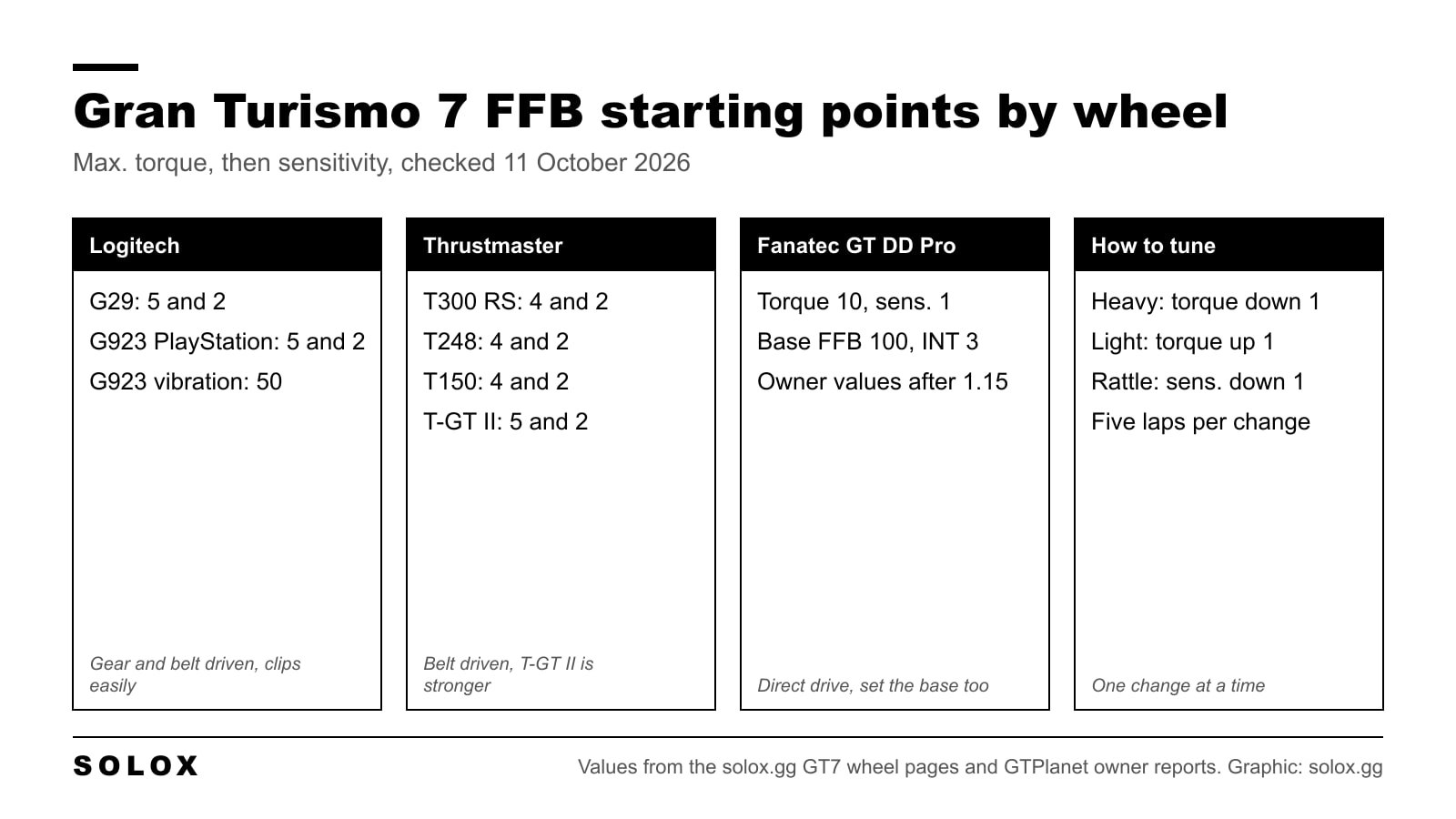
| Wheel | Max. torque | Sensitivity | Page |
|---|---|---|---|
| Logitech G29 | 5 | 2 | GT7 Logitech settings |
| Logitech G923, PlayStation version | 5 | 2 | GT7 Logitech settings |
| Thrustmaster T300 RS | 4 | 2 | GT7 Thrustmaster settings |
| Thrustmaster T248 | 4 | 2 | GT7 Thrustmaster settings |
| Thrustmaster T150 | 4 | 2 | GT7 Thrustmaster settings |
| Thrustmaster T-GT II | 5 | 2 | GT7 Thrustmaster settings |
| Fanatec GT DD Pro | 10, with the base side set too | 1 | GT7 Fanatec settings |
These are starting points, not answers. The ranges owners use are wider, and each brand page shows them.
The Fanatec number is an owner report, not a Polyphony value. GTPlanet users who run the GT DD Pro on GT7 put max. torque at 10 and sensitivity at 1, with the base at FFB 100 and interpolation (INT) 3. They describe it as clearer but not stronger. My Fanatec page has the older belt and CSL numbers and still needs a proper pass.
Where the settings are
From the world map, open the menu with the GT logo in the top left corner, go to Options, then Controllers. Force feedback max. torque, force feedback sensitivity and the vibration function are there. You can also open the same screen from the pause menu on track, which is the fast way to tune: change a value, drive, pause, change again.
Countersteering assistance is a different place, in the assist settings. Turn it off. With a wheel in your hands you do not want the game steering against you. My GT7 assist settings page has the rest of that menu.
What the two numbers do
Force feedback max. torque. This is the overall strength. It scales every force the game sends to the wheel, so it also decides how heavy the steering is.
A low number gives you a light wheel that hides the information. A high number gives you a heavy wheel, and on a wheel with a small motor it reaches its limit in every fast corner. At the limit a bump, a kerb and a slide all feel the same. That is clipping. You want the highest value where you can still tell a smooth corner from a bumpy one.
Force feedback sensitivity. This decides how many small effects come through and how hard the short, sudden ones hit. Low gives you a calm wheel. High gives you more detail and more shake, and on a gear wheel more gear rattle. I stay low, 1 or 2, on every wheel.
Vibration function and vibration strength. This is a separate rumble layer for kerbs and the surface. On the PlayStation G923 it is what drives TRUEFORCE. It goes up to 150 and the default is 100. If the wheel buzzes all the time, take it down by 20 or 30.
Why old guides give you different numbers
Four updates changed what the same number feels like.
Update 1.15, in May 2022. Polyphony Digital said some wheel and car combinations were producing "excessively strong force feedback vibrations" that "could result in injury". As a stopgap it reduced the force feedback intensity and torque on the Thrustmaster T-GT, the Fanatec Podium and the Fanatec GT DD Pro, and promised more suitable sensitivity values for each wheel later. That is why GT DD Pro owners went to torque 10. I did not find a source that says a later update changed it again.
Update 1.49, in July 2024. It changed the handling model. Many G29 owners went up to torque 7 afterwards because the steering felt lighter. If your old guide says 4, the same car will probably feel a little lighter today.
Update 1.71, in August 2026. The official notes list adjusted steering response, force feedback and pedal input, and added Fanatec Auto Setup and FullForce support for the GT DD Pro.
Update 1.72, on 15 October 2026 (Spec IV Part 1). Force feedback was revised for the Thrustmaster T598 and the Logitech RS50 System, and the MOZA R5S Pro Racing Simulator got native support. The notes give no values, so if you run one of those, start again from the table above. The rest of the update is on my Spec IV update page.
So take any number from before July 2024 as the middle of a range, not as a value, and recheck after every update that names your wheel.
How to tune it for you
Pick one car and one track and do not change them. A Gr.4 or Gr.3 car on a track you know is the best test. Do five laps, pause, change one value by one step, and do five more.
| What you feel | Change |
|---|---|
| The wheel is heavy and you fight it in long corners | Max. torque down one step |
| The wheel goes light and tells you nothing | Max. torque up one step |
| The wheel rattles or shakes on the straight | Sensitivity down one step |
| Kerbs and bumps feel all the same | Max. torque down one step, the wheel is at its limit |
| You do not feel the rear start to slide | Sensitivity up one step |
Do not chase a heavy wheel. In a real GT3 car the steering is power assisted and lighter than most people expect. What I look for in a simulator is the same thing I looked for in the car: I want to feel the front tyres load up when I turn in, and I want the wheel to go light when they give up. If your settings give you those two things, they are right.
Heavier cars and lighter cars also feel different at the same setting. A Gr.1 car at speed asks more of the wheel than a Gr.4 car on a slow track. Tune on the car you race most.
Which wheels work
Your wheel has to be a PlayStation wheel. The Xbox and PC versions do not show up on a console. The two cases people ask about most:
- Logitech G920 and the Xbox version of the G923 do not work on a PlayStation.
- Thrustmaster TX and TMX are Xbox wheels and do not work. The T300 RS is the PlayStation version of the same base.
There is no single official list from Polyphony that I could open today. The third party lists I found name the Logitech G29 and G923, the Thrustmaster T300 RS, T-GT II, T248 and T150, and the Fanatec CSL Elite, Podium and GT DD Pro, and they do not agree on every model. Check the wheel's own product page for PS5 before you buy. If you are still choosing, see the best steering wheels for Gran Turismo 7.
FAQ
What are the best FFB settings for Gran Turismo 7?
Max. torque 5 and sensitivity 2 on a Logitech G29 or G923 and on a Thrustmaster T-GT II. Max. torque 4 and sensitivity 2 on a T300 RS, T248 or T150. Then move one step at a time.
Where are the wheel settings in Gran Turismo 7?
World map menu with the GT logo, Options, Controllers. You can also reach them from the pause menu on track.
Why does my wheel feel weak in GT7?
Raise max. torque by one step. If it still feels weak at 7 or 8 on a belt or gear wheel, the motor is the limit and a higher number will only clip. Check that the vibration strength is not at zero if the wheel also feels dead on kerbs.
Why does my wheel shake on the straight?
Sensitivity is too high, or the vibration strength is too high on a G923. Take sensitivity down one step first, then vibration by 20 or 30.
Do I need to set the wheel in G HUB or the Thrustmaster software?
No. On a PlayStation the wheel runs on the game's own settings. The game also sets the steering lock for each car, so leave rotation alone.
Did Gran Turismo 7 updates change force feedback?
Yes. Update 1.15 reduced force and torque on the Thrustmaster T-GT and the Fanatec Podium and GT DD Pro. Update 1.49 in July 2024 changed the handling model and many owners raised torque afterwards.