
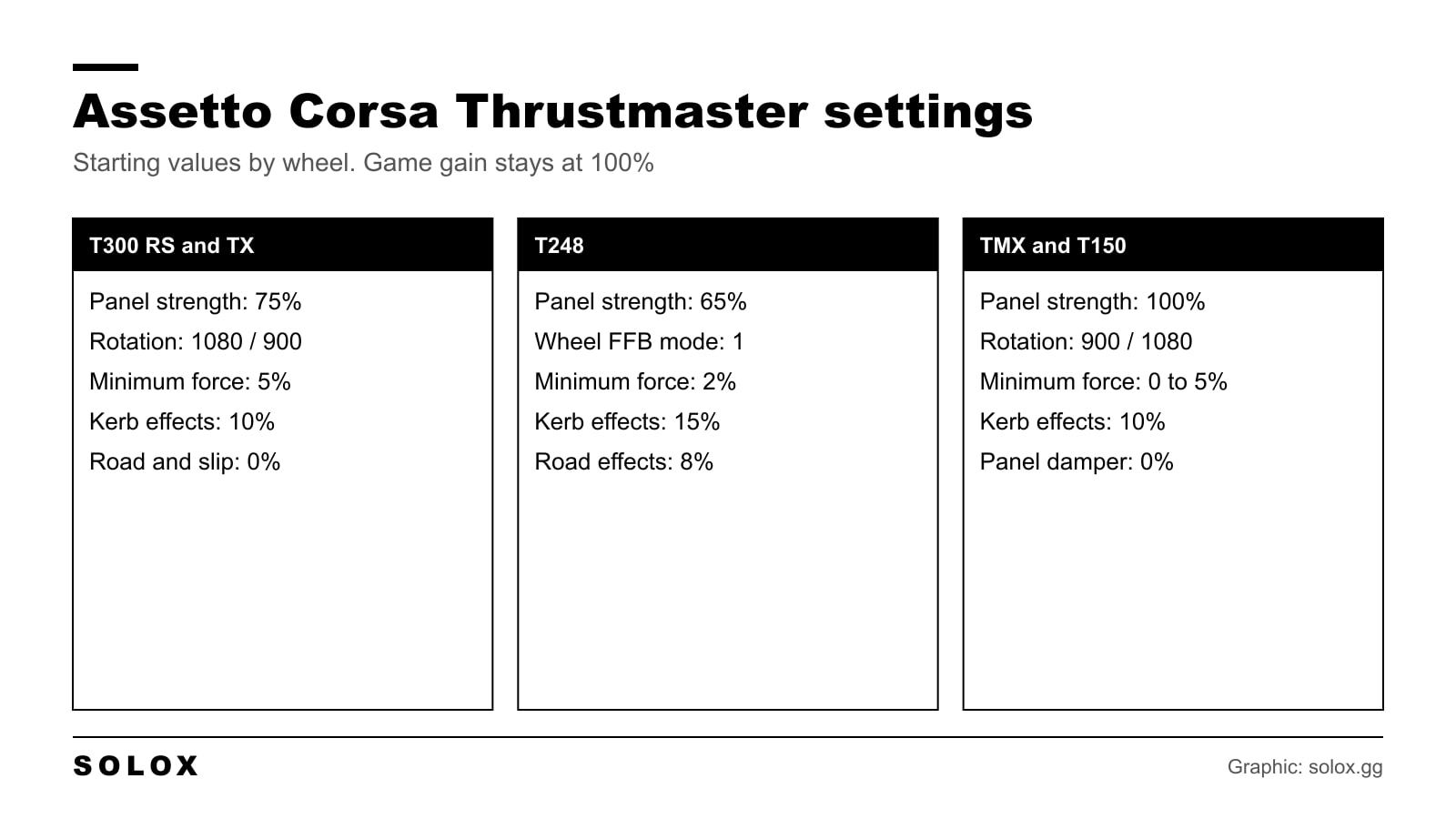
Assetto Corsa has some of the best force feedback of any sim, and a Thrustmaster belt wheel is enough to feel it. You only need a clean signal: full gain in the game, the strength set in the control panel, and almost no fake effects.
These are the values I would start from on each wheel, and how to adjust them.
The settings for each wheel
Two places. First the Thrustmaster control panel in Windows, then the game.
Thrustmaster control panel
| Control panel setting | T300 RS | TX | T248 | TMX | T150 |
|---|---|---|---|---|---|
| Rotation | 1080 | 900 | 900 | 900 | 1080 |
| Overall strength of all forces | 75% | 75% | 65% | 100% | 100% |
| Constant | 100% | 100% | 100% | 100% | 100% |
| Periodic | 100% | 100% | 100% | 100% | 100% |
| Spring | 100% | 100% | 100% | 100% | 100% |
| Damper | 100% | 100% | 100% | 0% | 0% |
| BOOST | Off | Off | Off | Off | Off |
| Auto-center | By the game | By the game | By the game | By the game | By the game |
To open it, search for Thrustmaster Control Panel in Windows, select your wheel and click Properties. The values are in the Gain Settings tab. Rotation is in the first tab.
On the T248 you also set three things on the wheel display: ROT 900, FORCE 4 bars and FFB 1. Mode 1 is the linear one. Modes 2 and 3 push up the small forces, which sounds good and then hides the difference between a small slide and a big one.
In game
| In game setting | T300 RS / TX | T248 | TMX / T150 | Range to try |
|---|---|---|---|---|
| Gain | 100% | 100% | 100% | Leave it |
| Filter | 0% | 0% | 0% | Leave it |
| Minimum force | 5% | 2% | 0 to 5% | 0 to 10% |
| Kerb effects | 10% | 15% | 10% | 0 to 20% |
| Road effects | 0% | 8% | 0% | 0 to 10% |
| Slip effects | 0% | 0% | 0% | 0 to 5% |
| ABS effects | 10% | 10% | 10% | 0 to 15% |
| Enhanced understeer effect | Off | Off | Off | Off |
| Half FFB update rate | Off | Off | Off | Off |
Take these as a start, not as the truth. Two wheels of the same model do not feel the same after a few years of use, and the right minimum force depends on your belt and your motor.
For how each of these sliders works on any wheel, see my Assetto Corsa force feedback settings.
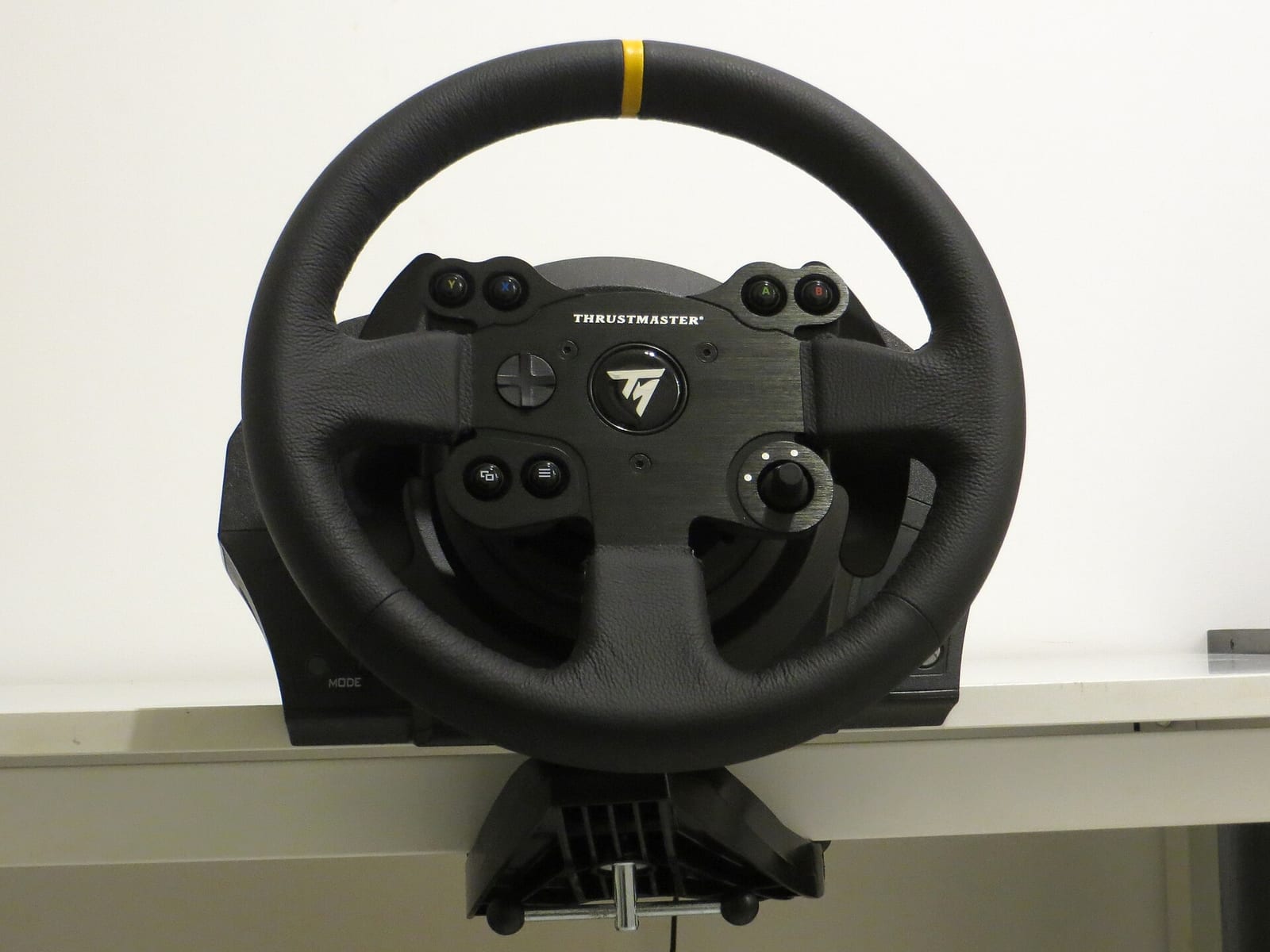
Where to find the settings in the game
- Open Options, then Controls.
- Select Wheel / Custom at the top.
- Run the configuration wizard once. It asks you to turn the wheel and press the pedals, and it reads the rotation.
- Go to the Advanced tab. Every force feedback value on this page is there.
If you use Content Manager, the same values are in Settings, Assetto Corsa, Controls. My guide on how to install Content Manager covers the setup.
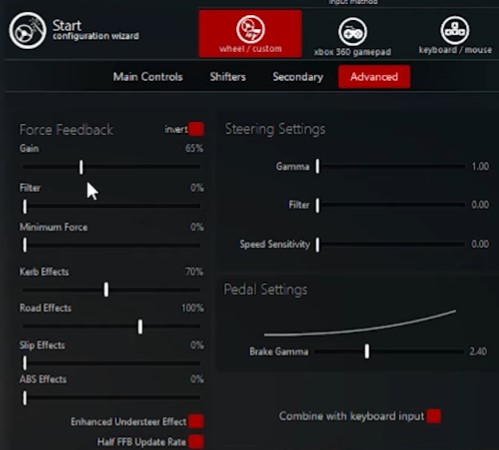
Why the strength goes in the control panel
The old advice for the T300 was gain 75% in the game. I would do it the other way now: 100% in the game and 75% in the control panel.
The result on your hands is close. The reason is order. With the game at 100% and no filter, the game sends the full signal and the wheel driver scales it once. You change one number in one place, and the per car setting in the game does the rest.
Why not 100% in the control panel too? On a T300 or a TX the motor gets hot at full strength. When it gets hot, the base cuts the force to protect itself and the wheel goes light in the middle of a race. At 75% it lasts much longer. The T248 has a different motor and gear system and 65% is where it feels the cleanest to most owners. The TMX and T150 are weaker, so they get all of it.
Minimum force
A belt and gear wheel has friction inside. Very small forces from the game are not strong enough to move it, so around the centre you feel nothing. Minimum force lifts those small forces above the friction.
How to set it:
- Take a car you know, on a track you know.
- Start from the value in the table.
- Drive a straight with your hands light on the wheel.
- If the wheel shakes left and right by itself, go down 1%. If the centre feels empty, go up 1%.
The right number is the highest one that does not make the wheel shake.
On the TMX and T150 there is a better way than minimum force, a lookup table (LUT) that corrects the response of the motor across the whole range. You measure the wheel with a small tool, it writes a file, and the game reads it from the file ff_post_process.ini in the cfg folder of Assetto Corsa in your Documents. With a LUT, minimum force goes to 0%. It takes ten minutes and it is worth it on those two wheels. Without it, use 5%.
Gain and clipping, car by car
The gain in the menu stays at 100%. What you change is the force of each car.
Every car in Assetto Corsa sends a different amount of force. A Mazda MX-5 is light. A GT3 car with slicks and downforce is heavy, and in a fast corner it can ask for more than the wheel has. That is clipping: the force is at the maximum, it cannot go higher, and you stop feeling what the front tyres are doing.
- On track, press numpad plus or numpad minus to change the force for that car. The game remembers it per car.
- Open the Pedals app from the bar on the right of the screen. It has an FFB bar. If that bar turns red in the fast corners, you are clipping.
- Lower the car until the bar goes red only on kerbs and bumps.
A little clipping on a kerb is fine. Clipping through a whole corner is not.
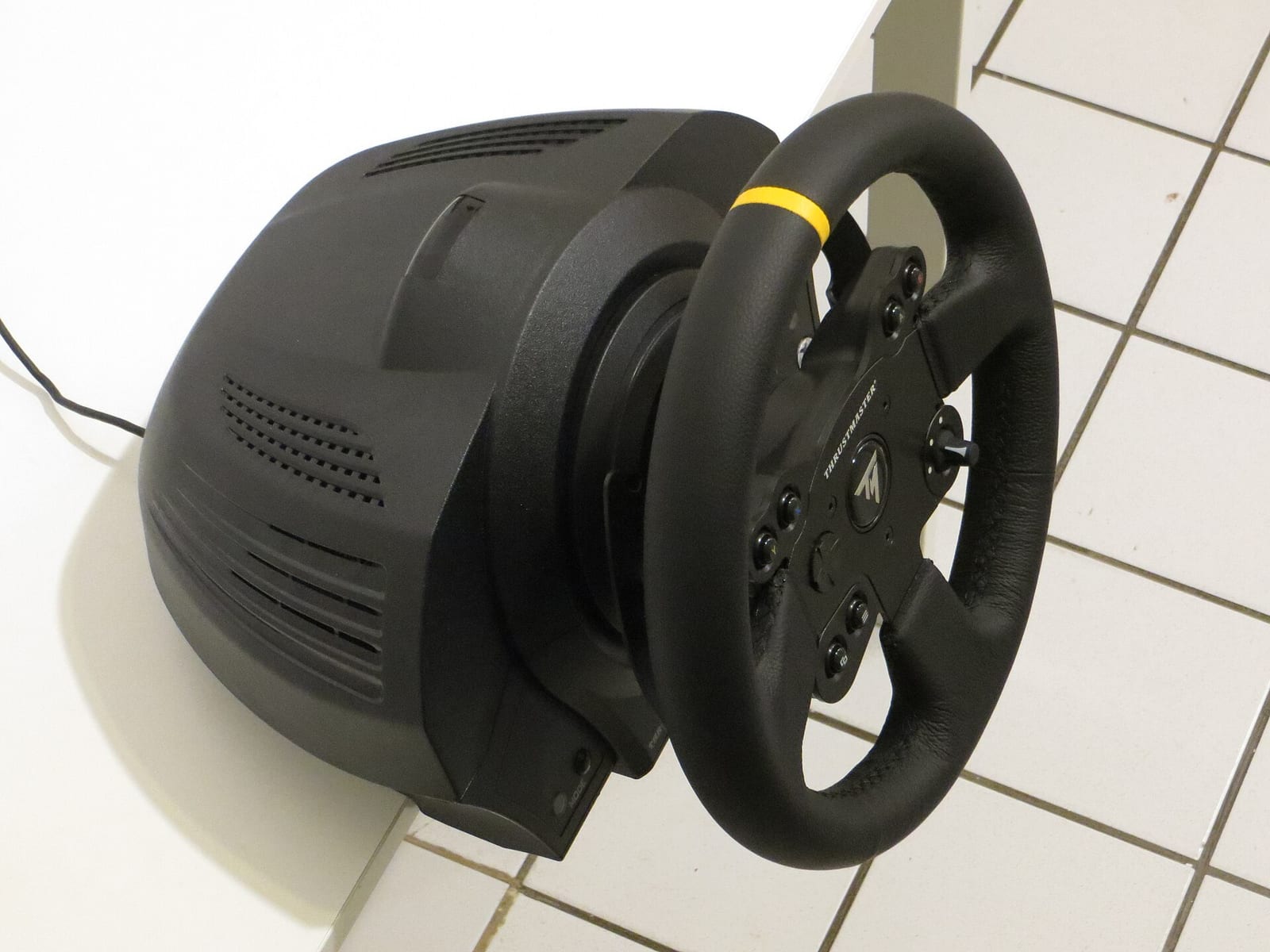
The effects: kerb, road, slip, ABS
These four are not physics. They are vibrations the game adds on top.
In a real car you do feel the kerbs and the surface in the wheel, but it comes through the tyre and the suspension, and Assetto Corsa already gives you that through the normal force feedback. The effects add a second, artificial layer. A little helps on a weak wheel. A lot covers the information you want.
- Kerb effects at 10% to 15% is enough to know you are on the kerb.
- Road effects at 0% on a T300 or TX. On the T248 a little, around 8%, gives some life to the straights.
- Slip effects at 0%. The wheel already goes light when the fronts slide. That is the signal to learn.
- ABS effects at 10% tells you when the ABS is working. If the car has no ABS, it does nothing.
- Enhanced understeer effect off. It makes the drop of force in understeer much bigger than it is. You get used to a signal that is not real.
Steering and pedals
| Setting | Value |
|---|---|
| Steering gamma | 1.00 |
| Steering filter | 0 |
| Speed sensitivity | 0 |
| Brake gamma | 2.40 (the default), lower it toward 1.00 with a load cell |
| Degrees of rotation in the wizard | Same number as the control panel |
Keep the steering linear. With gamma at 1.00 and the rotation matched, 90 degrees on your wheel is 90 degrees on the car, and the game sets the right lock for each car by itself.
Brake gamma depends on the pedals. With the standard T3PA or T-LCM set, try the default first. If the brake does too much at the start of the travel, raise the gamma. If you need to push too far before something happens, lower it.
Problems and fixes
| Problem | Fix |
|---|---|
| Wheel feels dead around the centre | Raise the minimum force one step at a time. Stop when the wheel starts to shake on the straight |
| Wheel shakes on the straight | Minimum force is too high. Go down by 1% until it stops |
| Force goes flat in fast corners | You are clipping. Lower the per car FFB with the numpad minus key |
| T300 or TX goes light after 20 minutes | The motor is hot and the base protects itself. Lower the overall strength to 60% or 65% and keep the fan area clear |
| The wheel on screen turns more than yours | Rotation in the control panel and in the wizard do not match. Run the wizard again |
| No force feedback at all | Close the game, open the control panel, check the wheel answers there, then start the game again |
| Kerbs feel like a drill | Kerb effects at 0% to 10%. They are a canned vibration, not the real kerb |
On PlayStation and Xbox
On a console there is no control panel and no Advanced tab like on PC. The game has a shorter list of force feedback options, and the base runs at its full strength. Use the same logic: gain high, effects low, and lower the gain a little if the force goes flat in fast corners. Rotation is set on the wheel with the MODE button and the D-pad, as the manual of each wheel shows.
Other wheels and other sims
- Logitech: Assetto Corsa settings for the G29 and G920.
- Fanatec: Assetto Corsa Fanatec settings.
- Same wheel in ACC: ACC Thrustmaster settings.
- Same wheel in iRacing: iRacing Thrustmaster settings.
Once the wheel feels right, the lap time is in the driving. My Assetto Corsa tips are the next step.
FAQ
What are the best Assetto Corsa settings for the Thrustmaster T300?
Control panel at 75% overall strength and 1080 degrees, game gain 100%, filter 0%, minimum force around 5%, kerb effects 10%, road and slip 0%, enhanced understeer off. Then adjust the force per car.
What rotation should I use in Assetto Corsa?
The maximum of your wheel: 1080 on the T300 and T150, 900 on the TX, TMX and T248. Put the same number in the wizard. The game then limits the lock for each car.
What minimum force should I use on a Thrustmaster wheel?
Around 5% on a T300 or TX and 2% on a T248. Raise it until the wheel starts to shake on a straight, then go back 1%.
Why does my T300 lose force feedback after a while?
The motor is hot and the base lowers the force to protect itself. Run 75% or less in the control panel and keep the vents clear.
Should I turn on enhanced understeer?
No. It makes the wheel go lighter than the car does, and you learn a signal that does not exist in other sims or in a real car.
How do I stop force feedback clipping in Assetto Corsa?
Open the Pedals app and watch the FFB bar. If it is red through the fast corners, press numpad minus to lower the force for that car.
Do these settings work in Assetto Corsa Competizione?
No. ACC has its own force feedback menu and different values. Use the ACC page linked above.